Pakkadavu 1
Playlist 71: Ananda Natanam
•
3m 33s
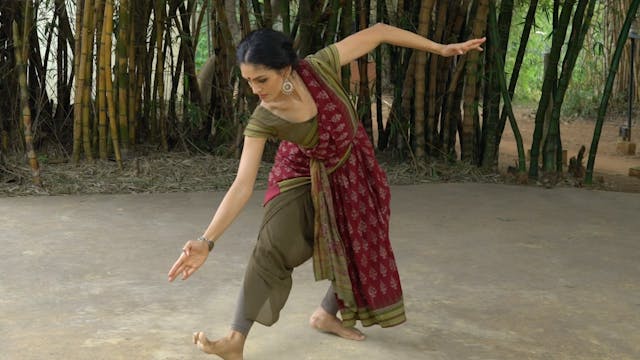
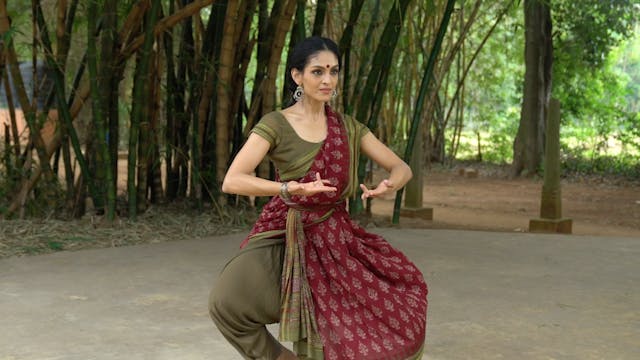
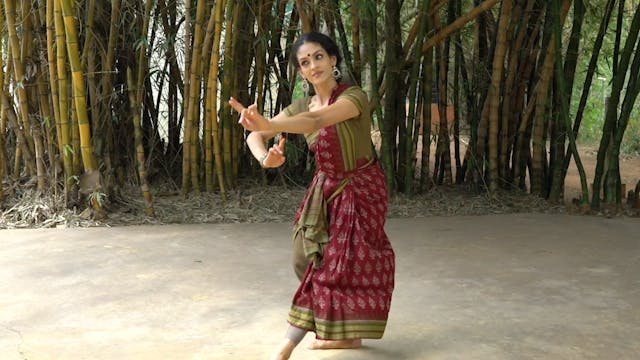
Pointers for Pakkadavu 1:
Watch the level of your arms. Make sure you maintain the length of your neck. Turn to the side with your head straight, without tilting. Keep your eyeballs in the centre of your eyes. When you reach to the side, do not raise the opposite elbow. maintain length.
The Pakkadavu name is derived from the movement of the entire body as opposed to a name derived from specifically the articulation of the feet. The Raadha Kalpa method practises four different types of Pakkadavu to create specificity in feet articulation. The movement of the arms are interchangeable and can be varied to an even greater number when placed in choreography.
The four types that are introduced, address with clarity four types of feet articulation in combination with most commonly used arm movements.
This progression is unique to the Raadha Kalpa method as it changes the starting and ending of each Pakkadavu by changing the use of Tattu in Araimandi or Swastikam.
Pay specific attention to the feet articulation in the Pakkadavu series. Start with the first one and then progress to the rest.
Up Next in Playlist 71: Ananda Natanam
-
Naatadavu 5
The 5th Naatadavu is fairly easier to execute if you are clear with the 3rd and 4th Naatadavu. The bend is in the diagonal, and the length of the back must be maintained. The Swastikam introduced in the second Naatadavu is used again. So as long as there has been clarity so far, this will be an e...
-
Kudiita Thattaduvu
Pointers for Kuditta Thattadavu:
Try to go down instead of hopping up each time you snatch onto your heels.
Keep dropping your tailbone and pushing your thighs back.
When you bend to the side, elongate your lower side, so the length of your top side and bottom side remain the same.
Do not push... -
Kartharee Adavu 1
The Kartharee adavu is a movement that begins with a jump, followed by the crossing of the legs. The name could come from the hasta that is used or from the fact that the legs cross.
The bends of the bodies vary in the various types of Kartharee adavu. We usually practice this Adavu to a three ...